Journeys
Cloud
Timothy M. Leonard's books on Goodreads
A Century Is Nothing A Century Is Nothing
ratings: 4 (avg rating 4.50)

The Language Company The Language Company
ratings: 2 (avg rating 5.00)

Subject to Change Subject to Change
ratings: 2 (avg rating 4.50)

Ice girl in Banlung Ice girl in Banlung
ratings: 2 (avg rating 4.50)

Finch's Cage Finch's Cage
ratings: 2 (avg rating 3.50)

Amazon Associate
Contact

Entries in education (382)

Tuesday
Sep242013

blind music

Once upon a story lived a tribe of kids. They laughed and played all day.

Poor ones collected cardboard and plastic water bottles along a red dirt road.

Kids with money went to school.

A blind man played his flute on the street. Memory answered as notes disppeared into the void.

A bird whistled. Poetic interpretation. 

A man without hands, a landmine survivor, blind in one eye stood near a cafe. His one eye smiled, he nodded his head, thank you after a well dressed man gave him money.

The rich man smoked a cigarette as friends discussed new business opportunities. They invested drug and prostitution profits in new glass and brass tourist hotels.

We have to put the money somewhere, said the rich man.

Yeah, said another man, we can't put it where our mouth is.

You can say that again, said his friend, giving a beggar child old notes.

Saturday
Sep142013

ugly chinese trash nepal and elsewhere

In a Bhaktapur, Nepal guesthouse it’s dinner time. Five Chinese aliens appear. Two males and three women. They are in their 20’s. They are armed with laptops, cell phones, and loud discursive language. This is normal.

Noise and confusion and interruptions and arrogant attitudes fit their life style. One girl is dressed like a flapper dancer from the roaring 20’s. Daisy Bell talks with her mouth full of rice. Her red diamond tiara squeezes her frontal lobe into a shucked pea. 

They are lucky to have a passport. Their parents are important Red Party Officials. It’s all about connections. They whined their way out of manners and intelligence in public places. They are the new breed of The Ugly Chinese, the lost, terribly frustrated never satisfied in their exported coddled spoiled youth.

They are the new emperors and empresses of a prosperous, for a minority, rising dynasty. They act like they own the restaurant. They complain about the price of a meal. One girl said in a shrill voice, “Oh, it’s too expensive. I am a poor student.” She is majoring in Stupidity and Callousness at Beijing Normal University. She failed Basic Courtesy 101.

A brat boy chastises the Nepalese waiter about his pronunciation of Menu. The crew cut Mandarin idiot commands the boy to say it again, Menu.

They are living, breathing examples of the spoiled one child political and cultural genocide legacy. It will come back to haunt China. They have the emotional maturity of a 15-year old. They are so busy stuffing their faces and talking over each other all the European guests stare at them.

They don’t care. They act and talk like this at home. A new strain of vociferous Chinese virus has been unleashed on Earth. Hong Kong residents call them locusts. 

Suddenly Flapper Dolly jumped up on the table yelling, Kill the Running Capitalist DogsMaking Money in China is Glorious!

Everyone threw their steel toed reinforced Everest hiking boots at her. She died of Shame. Her friends dragged her body out, selling the boots to pay for her cremation.

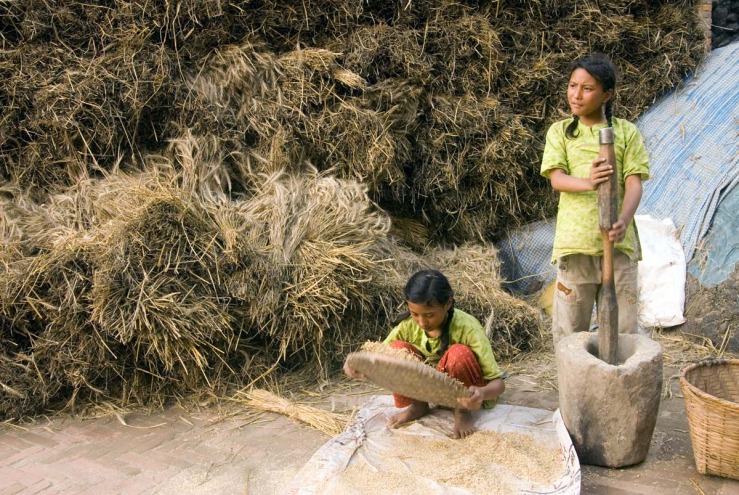
Brick boys in Kathmandu valley.

Twins work in Bhaktapur. 

Thursday
Sep122013

A story for Grade 4

“Many world tribes love to look back. It’s all passion and illusions of suffering. A genetic molecule of fear, doubt, uncertainty, surprise and adventure. A childish innocent curiosity lives in the present. As people age they want & need the past.”

“Living in the past is time consuming,” said a genius kid.

“Yes,” said a teacher, “Focus on your needs not your wants. Your need for freedom and freedom from need. Needs manifest a desire for a memory or a ghost or a regret. We are all passing through. Humans look back to see if they see in their vivid reptilian imagination their ghost.

"A ghost from a family or friend looks for clues at their personal ground zero. They’ve evolved from distant galaxies. Java man was discovered here 40,000 years ago. Accepting an evolutionary premise, their DNA star chart continues its genetic dance today. Oh, and one more thing. Don’t let school interfere with your education. See you tomorrow.”

A wandering teacher lived in talking monkey zones. They eat rice. They drink water. They fuck. They breed. They wash one set of clothing and hang it on bamboo. They burn down the forest. They breed, work and get slaughtered. They harvest brooms. Shamans bring rain. Tropical downpours allow people the luxury to wash cars. They use faint energy looking behind them wondering, all the wondering and wandering and milling around. 

Food is cheap. Let’s eat mantra. This has nothing to do with simians. It has nothing to do with the two women sitting in a dark warung neighborhood food joint near a private school.

The warung faces a tall cinder block wall. Chickens, goats and cats prowl, peck and forage through garbage. One woman sits in a deep meditation. Her friend parts her hair looking for insects, cleaning her scalp. They take turns cleaning and inspecting. This genetic behavior is repeated in zoos, jungles and rain forests. Chattering storytellers play the gamelan pounding out 40,000 year-old tunes.

Heal people with music. Music is the fuel.

Males wash toy machines and study accumulated grime under long yellow curling fingernails. They play chess waiting for passengers. Checkmate, said Death.

They visit the warung to chat up girls while eating spicy rice mixed with tofu, chicken, veggies, green chilies and deep-fried snacks. One explorer creates a Brave New World. They forge new futures with cold, detached logical intention. They create an assessment on process in a data based star cluster.

Friday
Jul262013

Anaemic

My name is Yeah Yeah and here's one of my favorite fairy tales.

Once upon a time I was in power since 1900. A century is nothing. I am not going anywhere. A black hole named Greed swallowed my country. Delicious. Burp. 

Greed is good.

My buddies go to the bank in Land Rovers. Cruise control.

China is my best friend in the whole wide world. They've invested a cool $12 billion since 2002.

They know BIG profit when they see it, smell it, hear it, taste it, feel it and cash it.

Money in-money out is their mantra.

Here's some recent World Bank numbers to verify our stellar accomplishments.

1. Our economy expanded at an annual rate of 7.2% in 2012. Domestic consumption is up. Toilets are expensive and rare. Cell phones are cheap and plentiful.

2. Direct foreign investment last year was $1.5 billion.

2. Our per capita income is $946 a year. Thailand is $5,474 and Indonesia $3,557. 

3. Less than 14% of my people, by the people and for the people are enrolled in tertiary education. Education wastes time and money.

4. 55% of our children under five are anaemic. I don't know what that means speaking of vigor or energy. I hope it's not contagious. If it is we need another hospital filled with empty rooms to impress foreign investors.

5. Vitamin and mineral deficiencies costs my country $146 million each year.

6. Malnutrition and poor health stunts the growth of 40% of our children. 

It's a numbers game.

Robust growth is one thing. Inclusive growth is another.

Wednesday
Jul102013

Giving Back on The Road

June was from Stockholm, Sweden. She visited Cambodia for a month. 36-years young.

She was a tight bundle of burning anxieties. “I don't know what I’m running away from. I don’t know what I'm running toward.”

A traveler talked about Angkor temple labyrinths as an allegory of life.

One door opens and one door closes but the passages can be a bitch, whispered a Cambodian ghost.

June had evolved as a willing victim of old lies. She'd believed lying authority figures; family, husband, boss and friends. She’d believed old controlling attitudes and belief systems of others.

Her new day in Cambodia offered opportunities for awareness and growth. Like other humans, to become authentic she’d eventually face her deepest fears and shadows. Either that or keep running scared with a hellhound on her trail.

“I want to cut all my hair off,” she said in Siem Reap. It was long curling blond movie star mane quality. She went to a salon. She was nervous. She swallowed hard. A woman cut it off.

“I feel lighter now, transformed.”

June altered her outward appearance, releasing old anxieties. By cutting her hair with bright shiny silver scissors as a symbolic gesture, June realized how she felt was more essential than how her stone cold colleagues in stone cold freezing Sweden might react. It was a small significant step on her new path. 

One day she experienced the influence of a remote Khmer village on her consciousness. She visited My Grandfather’s House 53 kilometers from Siem Reap. They’d converted a two story building into a school.

“What do you need?” she asked the village chief.

“We need clean drinking water.”

She bought a water purifier.

“We need electricity after 6 p.m.”

She purchased a battery so they’d have lights after dark.

Another day, returning from Angkor she stopped in a village. She met children. The next morning she invited a traveler to join her. She purchased bags of toothbrushes and toothpaste. They rolled through dry brown flat countryside and palm trees past simple stilted bamboo homes, women selling, cooking, cleaning, washing and working.

They were far away from a neon town filled with tourists doing Angkor Wat.

June talked a blue streak, unloading her honesty, hopes and dreams mixed with anxieties and fears, “I feel good doing this. I've never done anything like this before. My past life was all about anger, problems and conflicts. Now that I’m in Cambodia, what, less than a week, I’m beginning to learn about myself, seeing how my life was empty with no meaning. How it was all about pleasing others, buying useless things to make myself feel better.”

They turned onto a thin dirt track leading to a bamboo thatched home in a field. Half-naked kids played. Women and men rested in shade. June met the kids and a young mother.

“Here,” she smiled, handing them toothbrushes and toothpaste, “these are for you.” They were amazed. An 80-year old woman, a former Apsara dancer, performed quick delicate hand movements. June copied her to the delight of everyone.

“I’ll be back,” she yelled as kids waved goodbye. 

“I now feel more fulfilled.”

They stopped in a market village for coffee. Young girls selling small colorful bamboo paper birds descended on them. “Buy something? Look at my things.”

June met Leaf, 13, in the 5th grade. Leaf learned English selling to foreigners at temples after school. She taught village kids English.

“I saw a leader in the girl’s eyes,” June said. “Maybe I can help her, get an English teacher for her village. Give her an opportunity to really grow.”

June had to modify her dream for the girl. “Let's be practical,” the traveler suggested, “finding a Khmer English teacher for $40 a month in this area is like finding clean drinking water.”

The next day June bought a brand new pink bike for Leaf with a bell and basket. It said, NEW STAR on the chain guard. She went to a bookstore. She bought a whiteboard, markers, 20 English learning books, picture dictionaries and storybooks. She loaded them on a tuk-tuk and returned to the village. Leaf, her family and friends were waiting. They raised pigs, dad kills them, mom sells the meat in the market, older sisters hope to find a foreign boyfriend, get married, and escape.

“Here Leaf all this is for you,” said June. “The bike will help you get to school, temples and home. The whiteboard, markers and books will help you teach English.”

Leaf smiled. “Thank you.”

Leaf pedaled through dust and brown broken leaves around the house. June spread the books out. Kids explored new images, words, ABC alphabets and colors.

“I feel real good about this,” she said returning to town. “Real good. I’ve made a small difference in a young girl’s life. I am so grateful.”

***

On another toothbrush run June traveled along a remote dusty red road. She stopped at a bamboo shop selling small bags of soap and bananas.

A young girl wore a permanent tear on her left cheek. She was not smiling. Her t-shirt had a picture of a skull and bones.

Danger! Mines!

She said to June: “Here I am. I communicate my reality to the world. Do you like my shirt? Can you read words or do you need a picture? How about a picture of a picture? I don’t know how to read so I like to look at pictures. 

"My country has 14.5 million people and maybe 6-10 million land mines. Adults say there are 40,000 amputees in my country. Many more have died because we don’t have medical facilities. Mines are cheap. A mine costs $3.00 to put in the ground and $1,000.00 to take out of the ground.

“I’m really good at numbers.

26,000 men, women and children are maimed or killed every year in the world by land mines leftover from ongoing or forgotten conflicts. Reports from the killing fields indicate there are 110 million land mines buried in 45 countries. It will cost $33 billion to remove them and take 1,100 years.

"Governments spend $200-$300 million a year to detect and remove 10,000. Cambodia, Angola, Iraq, and Afghanistan are the most heavily mined countries in the world.

“40 percent of Cambodian land is unused because of land mines. One in 236 Cambodians are amputees. A prosthetic limb costs $3,000.

“Talk to me before you leave trails to explore the forest. It's beautiful and quiet. I know all the secret places.

"I showed my picture to a Cambodian man and he didn’t like it. They call this denial. He said it gave him nightmares. He’s seen too much horror and death in one life. So it goes. My village is my world. Where do you live?”

June's humbling life changing experience woke her up in Cambodia.