Journeys
Cloud
Timothy M. Leonard's books on Goodreads
A Century Is Nothing A Century Is Nothing
ratings: 4 (avg rating 4.50)

The Language Company The Language Company
ratings: 2 (avg rating 5.00)

Subject to Change Subject to Change
ratings: 2 (avg rating 4.50)

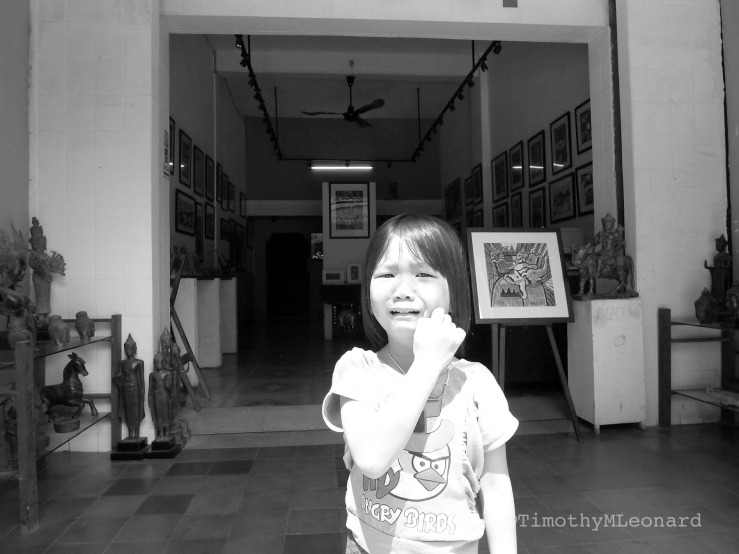
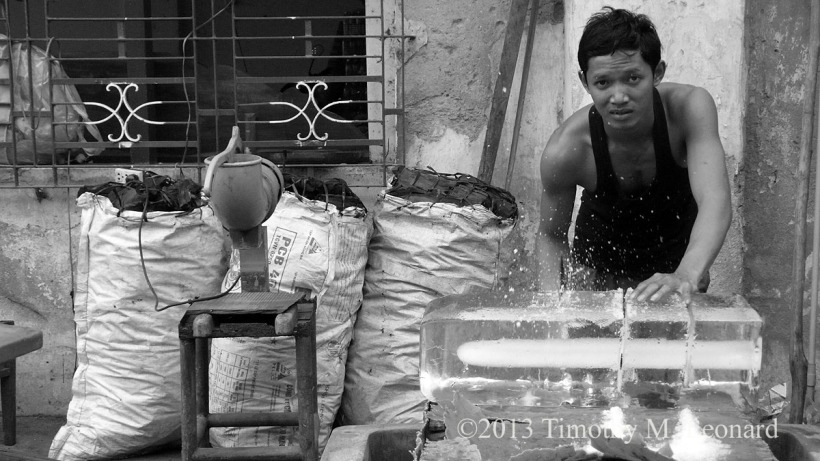
Ice girl in Banlung Ice girl in Banlung
ratings: 2 (avg rating 4.50)

Finch's Cage Finch's Cage
ratings: 2 (avg rating 3.50)

Amazon Associate

Entries in quality of life (55)

Saturday
Jan112020

Landmines

“We are not here for a long time. We are here for a good time,” laughed Meaning, a twelve-year old survivor wearing a ragged Beware of Land Mines skull and crossbones t-shirt and prosthesis leg scampering a random life pattern across fields near a stilted bamboo home in Cambodia.

“Are you with us?” pleaded a landmine child survivor removing shrapnel with an old rusty saw after stepping in heavy invisible shit, “or are you against us?”

She’s been turned out and turned down faster than a housekeeper ironing imported Egyptian threaded 400-count linen. No lye.

The thermostat of her short sweet life seeks more wattage. She faces a severe energy shortage if she doesn’t find food.

She’s one of 26,000 men women and children maimed or killed every year by land mines from forgotten conflicts. Reports from the killing fields indicate 110 million land mines lie buried in 68 countries.

It costs $3.00 to bury a landmine.

It costs $300-$900 to remove a mine. It will cost $33 billion to remove them. It will take 1,100 years. Governments spend $200-$300 million a year to detect and remove 10,000 mines. Cambodia, Angola, Afghanistan and Laos are the most heavily mined countries in the world.

40% of all land in Cambodia and 90% in Angola go unused because of land mines. One in 236 Cambodians is an amputee.

*

Expanding her awareness of mankind’s genetic stupidity, Lucky showed Zeynep a Laos map illustrating Never-Never Land.

Lao Please Don’t Rush is the most heavily bombed country in history.

25% of villages in Laos are contaminated with UXO.

Upwards of 30% of the bombs dropped on Laos failed to detonate.         

80 million unexploded bombs remain in Laos.

More than half of the UXO victims are children.

*

Meaning hears children crying as doctors struggle to remove metal from her skin. She cannot raise her hands to cover her ears. Perpetual crying penetrates her heart. Tears of blood soak her skin.

The technical mine that took her right leg away one fateful day as she played near village rice paddies expanded outward at 7,000 meters per second. Ball bearings shredded everything around her heart-mind.

It may have been an American made M16A1, shallow curved with a 60-degree fan shaped pattern. The lethal range was 328 feet. Or maybe it was a plastic Russian PMN-2 disguised as a toy.

She never saw it coming after stepping on the pressure plate.

Fortunately or unfortunately she didn’t die of shock and blood loss. A stranger stopped the bleeding, checked her pulse and injected her with 200cc of morphine. Strangers in a strange land carried morphine.

*

Cut the heavy deep and real shit, said a female Banlung shaman.

Fear is a tough sell unless it’s done well, well done, marinated, broiled, stir-fried, over easy, or scrambled.

Fear is blissful ignorance.

Weaving A Life V 1


Wednesday
Jul242019

The Garden #4

Cambodian Land Mines is the title of this podcast.

It's also available in Weaving A Life (V1), Kindle and paperback.

A survivor shares her story.

Thanks for listening.

The Garden #4

Thursday
Jul042019

Take The Orange Pill

Another brilliant Banlung day bloomed bright. Infinitesimally small intense waves and particles traveled at 186,000 miles per second.

What you don’t see is fascinating, said Ice Girl. She and Leo heard the clatter of tourist utensils singing near dumb thumbed Angkor Wat guidebooks dancing with dusty beggar children hawking vignettes at a medical clinic.

The Angkor Children’s Hospital in Siem Reap has 22 beds in one room. They are filled with infants wearing air hoses in their nose. They suffer from pneumonia, tuberculosis and dengue. This is common. A parent holds a tiny hand.

I.C.U. has five occupied beds.

400 mothers cradling kids wait to see a nurse. She dispenses free orange generic pills.

Life is a killer. Life is a generic placebo.

The mothers are happy to get SOMETHING, anything. They have no knowledge about modern medicine.

One effective blue pill costs $1.00. Parents need to buy 15. 

$15.00 is a fortune. Out of the question. Parents accept free ineffective orange drugs. Parents need a miracle.

How much does a miracle cost?

Mothers are hopeful. They wait. They have ridden on the back of cycles from distant villages. Everyone there had an answer for the child’s sickness. Babble voices of genocide female survivors sang remedies. Men pounded drums. Relatives prayed and burned incense.

A shaman dancing with death smeared chicken blood over a tiny chest. Another healer waved smoking banana leaves over a child running a fever.

400 mothers waited forever to see a nurse and get an orange pill.

Chapter 22 Ice Girl in Banlung

Ling's art in Laos

Tuesday
Jun252019

Conversation Dies

"He didn't believe in countries and the only borders he respected were: Borders of dreams - musty borders of love & indifference. Borders of courage or fear - golden borders of ethics.” - Roberto Bolano

The beauty of travel is the anonymous sensation in a crowd.

On a Sunday all the Khmer men gather for coffee, tea and stories.

Do you take milk with your stories, said one. No, straight.

Some study another's face and words.

The majority study cell phones or a Thai music TV video.

I love my phone, said one, it allows you to give up your consciousness.

Others study a conversation disguised as a peddler pulling his trash cart

down a street squeezing air out of a worn plastic bottle to summon the attention

of a survivor waiting to hear the air

knowing they can pawn junk,

perhaps an old family heirloom or weaver's word loom

in a Lao village along a river stream of consciousness.

No one bothers the stranger writing or drawing in a notebook.

He's been here many times, many places on Earth.

Men sit and stare. Trembling eyes pursue the endless stream of life.

When a face-to-face conversation dies someone picks up their phone to call another conversation.

I just called to see if you're alive. Amazing.

Have you eaten?

Yes. Today was eggs and rice, tomorrow it's lobster. Ha ha ha.


Wednesday
Apr032019

Bahrain-Brunei

I worked in Kuwait from 1985-1988.

Brunei enacting anti-LGBT laws reminded me of meeting Dave in Bahrain. He lived in Saudia Arabia and told me a story.

I put his story in two books, A Century is Nothing, and Weaving A Life, V1.

______


It was raining in the desert before Christmas as Gulf Air Flight 212 departed Kuwait. I encountered gray turbulence in neutral airspace where Islamic law against the consumption of alcoholic beverages had no influence.

By Carlsberg numero dos we were at 25,000 feet in blue sky and white thunderheads. Airmobile again.

In Bahrain I collected a visa stamp, took a cab to the Diplomat Hotel and room 621 with an excellent view of the aquamarine Gulf and new civic center construction project.

I opened windows, an ice cold beer, calibrated rock and roll music on the radio and ordered a three-egg omelet with hash browns and whole wheat toast complimented by thick Turkish coffee. A Filipino waitress in pink room service motif brought it up.

The next afternoon I took Taxi #1 into Bubba Bahrain, a maze of haphazard streets. I bought vitamins at a pharmacy and escaped expensive shopping zones entering the old suq lined with herbs, spices, textiles, fruits, vegetables, secondhand watches, goats, sheep, brooms, tea and ancient emulations.

From an inside secret pocket of a worn olive drab photographer’s vest, I pulled out a small, simple and precise European designed 35mm range finder camera loaded with 125 ASA black and white film; a gift from the gods of optical ingenuity, a well-designed tool, a work of art.

I imagined a donkey's head covered in burlap feed bag to prevent attacks on unsuspecting humans. Down twisted alleys I wandered, shooting old men and women, trapping spirits on negatives. Children’s faces were captured forever wearing cartoon character masks with innocence preserved behind wide glowing eyes.

Delicate eroding architecture, thatched reeds on woven bamboo poles embedded in mud, iron grated windows and carved balconies of blue and white mosaics were threaded into a black canister.

In early evening I stopped at a Persian carpet retailer to learn about his business. Over endless cups of tea he shared facts:

1. There is a difference between “expert” and “well knowledged (sic).”

2. Carpet making is based on tradition, history, quality and time. Takes 14 months for some carpets.

3. Design and a particular technique is required to produce a good quality carpet.

4. His carpets were woven and stored in a warehouse in Iran before being smuggled by dhow to a Dubai wholesaler. A buyer in Bahrain purchases them by the bundle paying a single price for the lot before shipping them to the shop.

5. Cotton costs BD (Bahraini dinar) 2/lb.

   Neck wool BD 7/lb.

   Silk BD 9/lb.

6. Good prices were available now with the recent devaluation of the Iranian Rial.

7. Be aware of specifics. Is it pure silk or combed wool? What are the precise number of knots per square inch?

I thanked him and walked to the Dolmen Hotel, an old foreign oasis constructed for aircrews. Interior pseudo classic Arabic architecture featured vaulted windows, wattle thatch and poles on low ceilings.

Dave, from the Twin Cities sat at the bar complaining about needing a third operation to correct poor metatarsal bones in his left foot. Saudi doctors messed him up twice so he came to Bahrain for another operation.

"I saw three Filipino males have their right hands cut off in Riyadh for stealing,” he said, meaning Sharia law. “Justice is served every Friday at high noon in the town square. Authorities tied their arms down on boards to support the wrists.”

 “Amazing,” I said.

“Yes," Dave said. "The multawa, an official, approached one man, flashed his sword into the air and severed his right hand off. He screamed. The multawa moved down the line doing his job. Another man carrying a blazing torch applied fire to the stump to cauterize the wound.”

Lynnette, a 31-year old Filipino waitress at the Dolmen was pleasant, lonely and bored. After five years doing cashier work in Manila she found a job in Bahrain.

“My dream is to save money and buy a house back home.”

“Do you like it here?”

“Not really. The wages are poor, they give us lousy Indian food and there’s no social life.”

“Why’s that?”

“Hotel management locks us in at 7 p.m.”

“Sounds like slave labor. Been going on in the Gulf for a long time.”

“Well," she sighed, "it’s just a job. It's not forever.”

At happy hour, the Intercontinental Hotel was jammed with Arabs, English investment suits and punkers. I ordered a beer at the bar. A small Bahraini man asked questions.

“Where are you from?”

“Everywhere.”

“What do you do?”

“I kill people. I'm a mercenary.”

“I don't believe you,” said his eyes.

“Yes. I kill people for a living. I am very busy 24/7. It’s a job. It passes time. People pay good money for me to take care of their problem. I’m paid to clean up other people’s messes. The only rule is no woman, no kids.”

He wanted to know something about his life. I predicted his age, family history, occupation and future. He left me alone.

Outside the Kuwait suq battered red and white rusting water trucks with chipped paint stood idle inside a wire compound leaking H2O into dust. Two Bedouins sat on metal folding chairs with crushed plastic buckets and sacrosanct rags collecting dust near the Fifth Ring Road waiting for drivers needing a car wash.

Waiting was their patient life in the desert, waiting for dusty cars, waiting for oil to be discovered below sand, waiting inside an omnipresent yellow haze swallowing everything.

A Century is Nothing

Weaving A Life V1
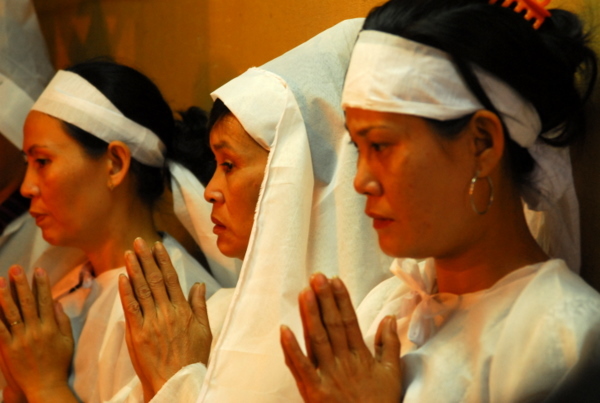
Funeral in Ho Chi Minh