


 Share Article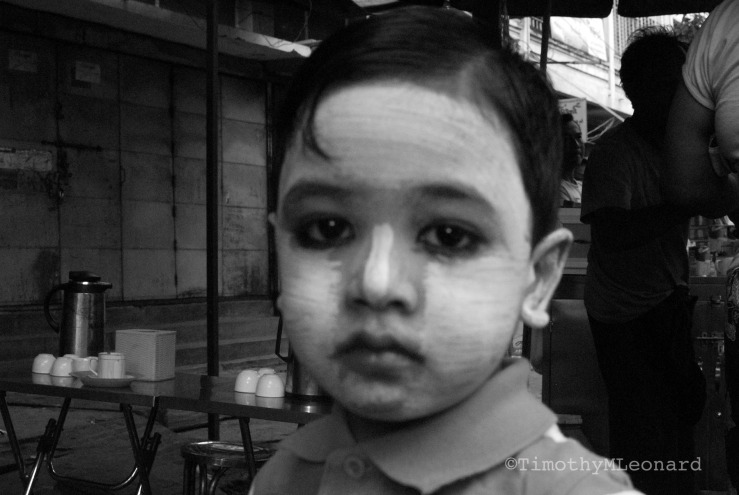
Conversation Dies
"He didn't believe in countries and the only borders he respected were: Borders of dreams - musty borders of love & indifference. Borders of courage or fear - golden borders of ethics.” - Roberto Bolano
The beauty of travel is the anonymous sensation in a crowd.
On a Sunday all the Khmer men gather for coffee, tea and stories.
Do you take milk with your stories, said one. No, straight.
Some study another's face and words.
The majority study cell phones or a Thai music TV video.
I love my phone, said one, it allows you to give up your consciousness.
Others study a conversation disguised as a peddler pulling his trash cart
down a street squeezing air out of a worn plastic bottle to summon the attention
of a survivor waiting to hear the air
knowing they can pawn junk,
perhaps an old family heirloom or weaver's word loom
in a Lao village along a river stream of consciousness.
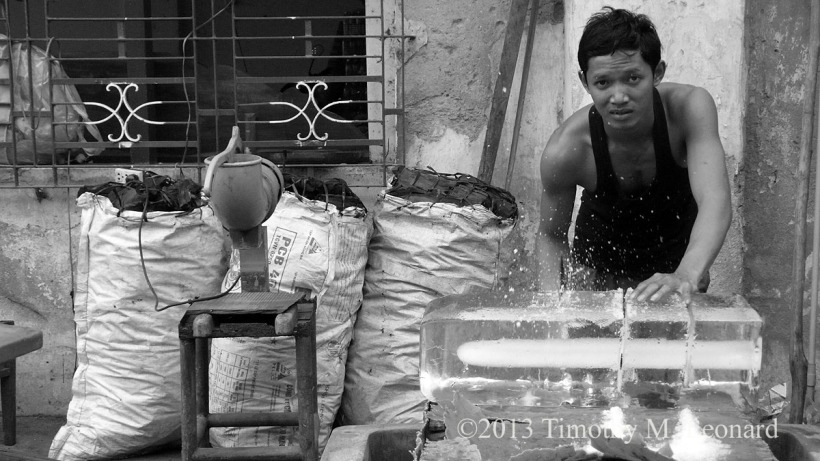
No one bothers the stranger writing or drawing in a notebook.
He's been here many times, many places on Earth.
Men sit and stare. Trembling eyes pursue the endless stream of life.
When a face-to-face conversation dies someone picks up their phone to call another conversation.
I just called to see if you're alive. Amazing.
Have you eaten?
Yes. Today was eggs and rice, tomorrow it's lobster. Ha ha ha.

A Jungle Story
Once upon a time in the long now there was a continent, a landmass floating on water. White barbarians called it Asia on dusty maps. Deep inside Asia were vast lands, rivers and mountains.
Overtime and Other, historical bandits with a reputation for laughter, art, music, magic and diverse languages and cultures lived in jungles, forests and remote mountains.
Jingle, jangle, jungle. Using natural materials they created musical instruments, simple weapons, homes, fish traps, snares and looms. The women had babies, wove cloth and prepared food while the men fished, planted crops, domesticated animals. Children played and learned life lessons from nature with extended families.
One day a boat filled with white men sailed up river to a village deep in the jungle. They wore shiny clothing, spoke a language the people could not understand and carried weapons that made a lot of noise and scared everyone. They pretended to be friendly by offering gifts. The leader of the village welcomed them. They had a party. The village gave them hospitality, shelter and friendship.
The white men took CONTROL of the village, people and jungle.
Every day more white people came up river on boats named Destiny. They were on a quest for gold and slaves. Owning, using and discarding slaves had proven to be an essential part of their evolution on other continents.
Their mantra was: cheap labor, cheap raw materials, cheap goods, cheap markets and much profit.
White people said, we are civilized and you are savages. We have religion. It is called Wealth & Greed. We are on a mission from the great chief. We control people. We control nature. We have machines. We take what we want.
Every day the white men marched their slaves deep into the jungle singing, “We control Nature. We shall overcome.”
They spread diseases. They planted fear. They planted envy and jealousy. They manipulated villages against villages. They divided people against people. Divide and conquer. History taught barbarians well.
They harvested wealth in the form of people, precious stones, rubber and every raw material of value. They were never satisfied. Their appetite grew and grew.
If we want to survive we have to move to a new jungle far away, said the village shaman. This is the story they told their people one night below stars singing with their light.
Teachers Meet in China
Yes. English teachers unite at a university in Fujian, China.
Let's get dressed and gather our Moleskine notebook filled with poetry, drawings, dreams, stories and visions. Let's collect one fountain pen filled with green racing ink. Remember water. You've gotta have H2O where you go. It's gonna be a hot one. Seven inches from the mid-day sun.
Let's go to a classtomb on old campus surrounded by luscious green trees straining to light. They are a canopy of welcome relief. Rose petals wither on the ground.
Smile and greet your compatriots, your stalwart educational guides. Take a seat. Look around. Engage your senses.
Gaze out the window toward the lake. It is shimmering. You hear scraping. What is it? Local workers are building a wall. A new Great Wall. Exciting. History in the making. How do they do it?
It's simple. Materials and raw labor.
Ten local village men and women - who do the heavy lifting - with bags of cement, trowels, shovels, a few plastic buckets, water, piles of gray bricks, empty drums for support, some boards, and a couple of wheelbarrows.
Step 1. Build rickety scaffolding using drums and boards. Remove the old steel fence. Discard to side.
Step 2. One team mixes cement and water. Shovel into buckets. Another team puts bricks into a wheelbarrow and pushes it to a dumping area.
Step 3. Men wait for women to hand them bricks and buckets of cement. They slather on the goop and align bricks. Brick by brick the wall goes up. It blocks the green sward, blue lake, rolling hills and wild flowers.
Only the sky is safe.
Step 4. Another team coats the exterior with a bland gray mixture.
It will never be finished. Art is like that.
It's so beautiful we feel like crying.
Someone steps to the podium and starts speaking - using exquisite language - about the value of education. Cost benefit analysis. Profit and loss statements. How we have a huge responsibility to our shareholders.
During a brief moment of silence you hear a shovel, trowel and laughter.
Another day blossoms in the people's egalitarian paradise.
Writing Is An Adventure
“’I did that,’ says my memory. ‘I can’t have done that,’ says my pride, and remains adamant. Finally memory gives way.” - Nietzsche.
The interpreter in the left brain strings experiences into narratives. A novelist in our heads. A novelist called memory ceaselessly redrafting the short story we call “My Life.”
Writing and telling a story is all about detail and realising the significance of the insignificant.
"Writing a book is an adventure. To begin with, it is a toy and an amusement; then it becomes a mistress, and then it becomes a master, and then a tyrant. The last phase is that just as you are about to be reconciled to your servitude, you kill the monster, and fling him out to the public." - Goethe
...In both Irish and Welsh myth and saga, the art of foretelling the future is an essential part of the story. More often then not, it is to escape their fate, prophesied by the Druid, that leads the protagonists into adventures which inevitably lead them to the fate they seek to avoid.
...At one point, the narrator irreverently criticizes the author and the book, saying: "You've slapped together travel notes, moralistic ramblings, feelings, notes, jottings, untheoretical discussions, unfable-like fables, copied out some folk songs, added some legend-like nonsense of your own, and are calling it fiction!"
- Soul Mountain by Gao
"I want to know one thing. What is color?" - Picasso
